| New Jersey Tint Laws | |
|---|---|
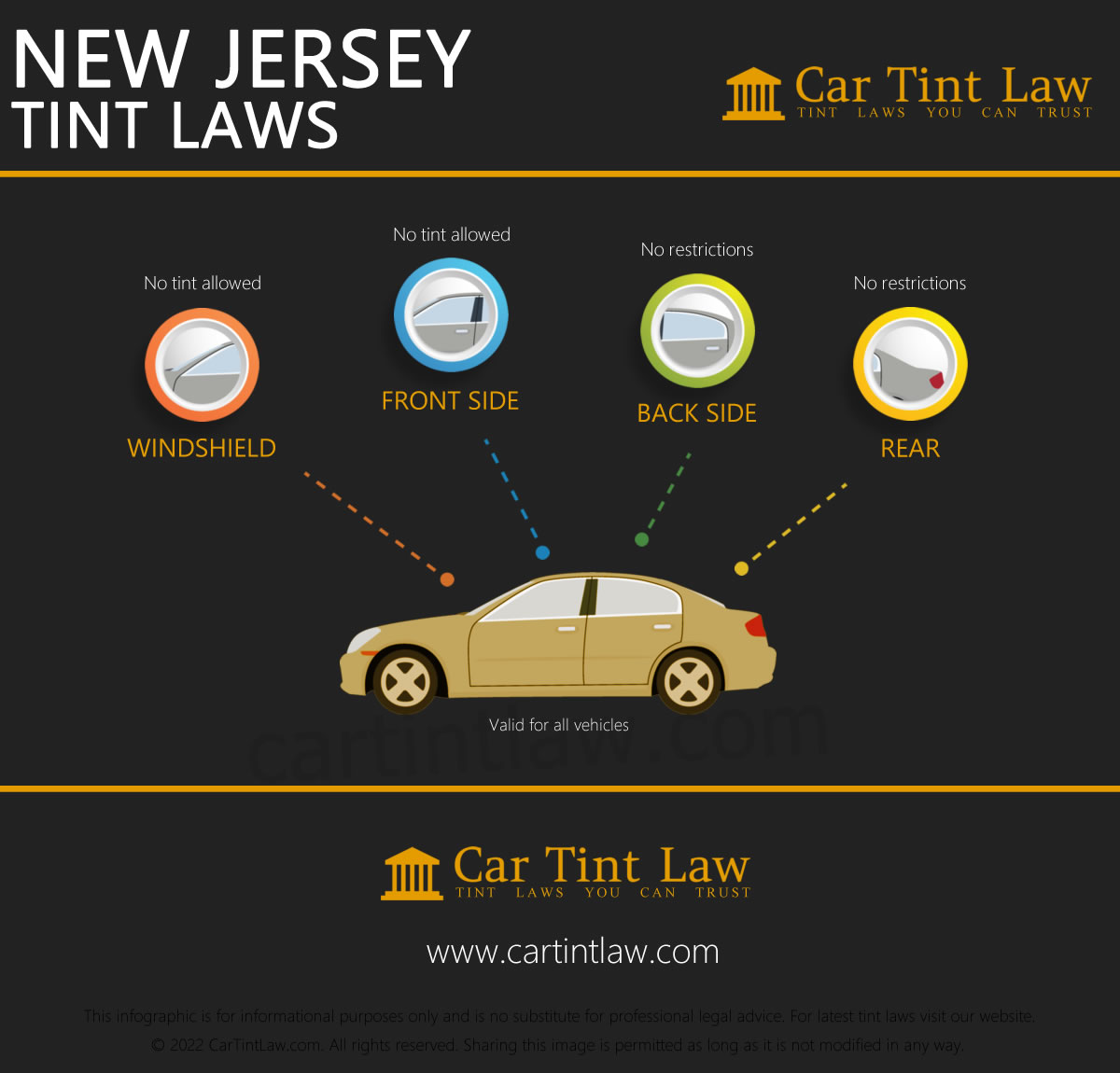
| Front Windshield | 70% on AS-1-line |
| Front Side Windows | No tint allowed |
| Back Side Windows | No restrictions |
| Rear Windshield | No restrictions |
Quick summary: New Jersey tint laws allow front windshield tint of 70% VLT but only on AS-1 line. Front side windows must not be tinted. All windows behind driver can have any darkness.
Last updated on: . Confirmed accurate for 2026. Attorney verified
New Jersey tint laws primarily regulate the darkness, but also specify other rules and regulations you need to know about such as reflectiveness or color restrictions. All laws are explained further below.
Window Tint Darkness in New Jersey
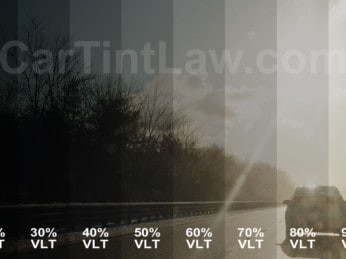
Window tint darkness is measured in VLT (Visible Light Transmission) percent. VLT indicates how much light passes through both the film and the glass.
Drag the blue slider above to preview tint darkness. In most real world cases, applied tint will appear 10-20% darker compared to our tool.
See: VLT explained with chart and darkness examples
How dark can your window tint be in New Jersey?
Here's exactly how much VLT is allowed on your auto window tint in New Jersey (NJ), categorized by passenger and multi-purpose vehicles.
Tint darkness for passenger vehicles:
- Windshield: 70% VLT tint is allowed on the windshield's AS-1 line (top ~5 inches).
- Front side windows: No tint is allowed on front side windows.
- Back side windows: Any darkness can be used.
- Rear window: Any darkness can be used.
Passenger vehicles include: sedan, coupe, convertible, station wagon, hardtop and hatchback vehicles.
Tint darkness for multi-purpose vehicles (MPV):
- Windshield: 70% VLT tint is allowed on the windshield's AS-1 line (top ~5 inches).
- Front side windows: No tint is allowed on front side windows.
- Back side windows: Any darkness can be used.
- Rear window: Any darkness can be used.
Multi-purpose vehicles include: SUV, pickup, van, truck, RV, and minibus.
AS-1 line typically extends between 4 and 6 inches parallel to the top of your windshield. AS-1 designation line is typically marked by glass manufacturer on the top edge of your windshield.
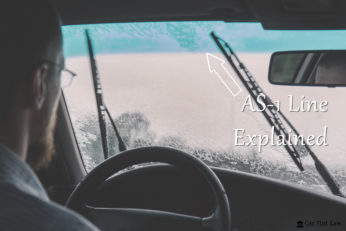
Depending on vehicle, your AS-1 strip may already be tinted. In most states windshield tint must not have any reflectiveness, and illegal colors typically include blue and red.
Some state tint laws specify exact number of inches you are allowed to tint on front windshields. Other states define this windscreen area simply as an AS-1 line. Learn more about AS-1 Line.
Federal vehicle ID label found on driver's front door frame will tell you whether your vehicle is classified as passenger or multi purpose vehicle.
- Passenger vehicles include: sedan, coupe, convertible, station wagon, hardtop and hatchback vehicles.
- Multi-purpose vehicles include: SUV, pickup, van, truck, RV, trailer, bus and minibus.
In most states vehicles fall under these two categories.
Other New Jersey Tinting Rules & Regulations:
Other laws, rules and regulations in New Jersey include the following:
Maximum 8% reflectance allowed.
Dual side mirrors are required if back window is tinted.
There are no tint colors specifically banned by New Jersey law. Under medical waivers, front windshield and front side windows must be clear film with no color.
Film manufacturers don't need to certify the film they sell in this state.
Sticker to identify material, manufacturer and tint installation facility is required on each windshield and window with tint (NJ Rev Stat § 39:3-75.2; N.J.A.C. § 13:20-1.8)
Medical Exemptions
To apply for a medical window tint exemption in New Jersey, complete the MVC Sunscreening 1 application form and have your physician fill out the medical certification section. Your doctor must identify your qualifying condition and provide a prescription for vehicle sunscreening. Email or snail mail both documents to addresses indicated in the form.
The NJMVC will review your documents and notify you of its decision. If approved, you will receive temporary authorization (MVC Sunscreening 2) and an installation confirmation form (MVC Sunscreening 3). You must take both forms to an NJMVC-approved tinting facility (see list). Do not install the tint before receiving approval, and always use a licensed facility.
After installation, the facility must sign the confirmation form. Send it to the NJMVC by email or mail to receive permanent authorization (MVC Sunscreening 4). Keep this document in your vehicle at all times. The exemption is valid for 48 months and must be renewed with a new application and physician’s prescription.
Initial application costs $150, and renewals are $100, payable to the Motor Vehicle Commission. With medical waivers, front windshield tint can have 70% VLT, and front side windows 60%.
Quick FAQs
Violating window tint laws in New Jersey is punishable with fines up to $1,000 under general motorized vehicle material provisions, though standard roadside tickets written under N.J.S.A. 39:3-74 often carry a base fine around $55 to $100 depending on the local municipal/state schedule.
Fines for second and subsequent offenses can rise to $5,000.
Retailers or shops that violate tint rules (such as failing to post warning signs, register with the Motor Vehicle Commission, verify medical cards or law enforcement status, or properly affix identification labels) face fines up to $5,000.
Our tint laws strictly reference official sources. You are welcome to verify data in official state laws linked below, or get in touch with your local DMV or police department to make sure you are not breaking New Jersey window tinting laws, rules and regulations.
Our article about New Jersey tint laws is up to date as of 2026. Last change was made on November 3rd, 2026 (approximately 1 day ago).
You can rest assured our legal experts are immediately notified of changes, and will always update this article with latest legislation when required.
Official law sources:
New Jersey Revised Statutes, Title 39 – Motor Vehicles and Traffic Regulation – Sections § 39:3-74 to § 39:3-75.3
New Jersey Laws – Title 13, Chapter 20, Subchapter 1 – Types of sunscreening materials and products [PDF file] – only for medical exemption tint
New Jersey Motor Vehicle Commission – Window sun-screening for medical reasons (instructions and licensed tint installation facilities)
N.J.A.C. 13:20: Standard and specifications […] medical exemption certificates – (fees in § 13:20-2.6 plus other medical exemption information)
New Jersey Motor Vehicle Commission – Medical exemption application form [PDF file]; Alternate mirror link
More New Jersey traffic law questions?
Our partnered traffic lawyers are always online and ready to answer your questions. Get immediate answers from real attorneys and experts in their field! Ask a question now »
Ask a lawyer »